Static Pressure on the Global Fuel Trade: The Energy Trade Outlook of 2026
- Jun 16, 2026
- 49 Views
Static Pressure on the Global Fuel Trade: The Energy Trade Outlook of 2026
The Strait of Hormuz is one of the most strategic maritime trade routes, serving as the primary gateway for crude oil, liquefied natural gas, and refined petroleum products.
As per the industry estimates and according to the Fuel and Oil Import Export Data, around 20% of global oil trade and a substantial portion of LNG shipments are traded across the Strait of Hormuz.
The disruptions in this critical shipment corridor are backed up by the global energy security and the freight cost, along with refinery operations. The visible trade across Asia has been mainly backed up by the dependence on imported energy supplies. The Global Import Export Data represented the Asian countries with an overall share of 84% of oil and 83% of LNG transported through Hormuz, China, India, Japan, and South Korea. The geopolitical tensions have been mainly influenced by shipping patterns, exporters, importers, refiners, and energy traders. The diversified sourcing strategies are getting improved mainly because of the resilience in maintaining the fuel availability.
Why is the Strait of Hormuz Important for the Global Energy Trade?
The Strait of Hormuz is a connecting route between the Persian Gulf, the Gulf of Oman, and the Arabian Sea. The narrow geographic width has been serving as one of the important maritime corridors in the world. Saudi Arabia, Iraq, United Arab Emirates, Qatar, and Kuwait, the countries popular as the major Gulf producers, have been reliant on this road to export crude oil, LNG, LPG, diesel, jet fuel, and other petrochemical products.
The disruption from the Strait of Hormuz may lead to different issues like delayed cargo movements, rising fuel prices, increased energy inflation, and supply chain uncertainty. The focus of the government authorities on the Strait of Hormuz is mainly because of its important role. The governments and the businesses are closely monitoring the Fuel and Oil Import Export Data for proper identification of sourcing alternatives in order to mitigate the risk associated with energy market volatility.
Latest Fuel and Oil Exporting Countries Amidst Hormuz Disruption 2026
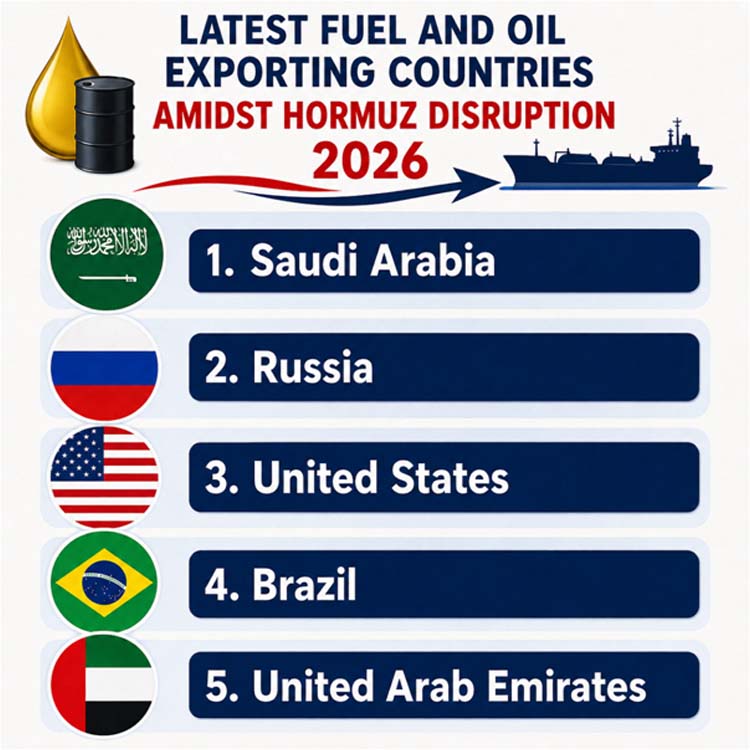
The sudden changes in the trade environment of Hormuz disruption have created different opportunities for the business authorities and the emerging traders to increase their market share in the fuel and oil trade. The countries mentioned below are the top exporters trading Fuel and Oil during the Hormuz Disruption in 2026.
1. Saudi Arabia - Saudi Arabia is one of the influential traders of fuel and oil amidst the Hormuz-related disruptions. The extensive production capacity of the region has redirected part of its exports through the West pipeline, mainly connecting the oil fields to the Red Sea. Saudi Arabia Export Data says the reduction in the dependence on Hormuz has increased the export flexibility of the nation regarding its fuel and oil trade. The critical role it plays in balancing the global crude market has promoted the availability of supply.
2. Russia - Russia is also a significant exporter of fuel and oil in 2026, and the country has also emerged as one of the largest beneficiaries of supply diversification efforts. The Russia Export Data reported that Asian buyers are the top authority seeking alternatives to Gulf supplies. The long-distance tanker shipments to China and India and have mainly supported the Russian market share growth.
3. United States - The United States also emerged as a major global energy exporter. As per the USA Export Data, the growing crude oil production and LNG export capabilities have facilitated American suppliers to serve as a strategic exporter of fuel and oil to both European and Asian buyers. The US crude oils have been the most attractive source for the importers during the periods of Gulf uncertainty. Despite longer transportation distances, the American export of crude oil, diesel, gasoline, LPG, and LNG has been supporting global energy security.
4. Brazil - Brazil is an increasingly important factor in the Atlantic basin supply. The alternative cargo availability in Brazil is a result of the offshore oil production. The Brazilian crude has been supporting the supply pressures associated with Gulf disruptions says Brazil Export Data.
5. United Arab Emirates - The United Arab Emirates, based within the Gulf region, has been reducing its dependency on the Strait of Hormuz while facilitating the export of fuel and oil. The Habshan Fujairah pipeline is the main factor that promotes the crude exports to the Gulf of Oman. UAE Export Data says the trade of fuel and oil from the UAE instead of the Strait of Hormuz through the Gulf of Oman has provided an important safety valve for the traded categories during the periods of maritime disruption.
The Leading Fuel and Oil Importing Countries During Hormuz Disruption (2026)
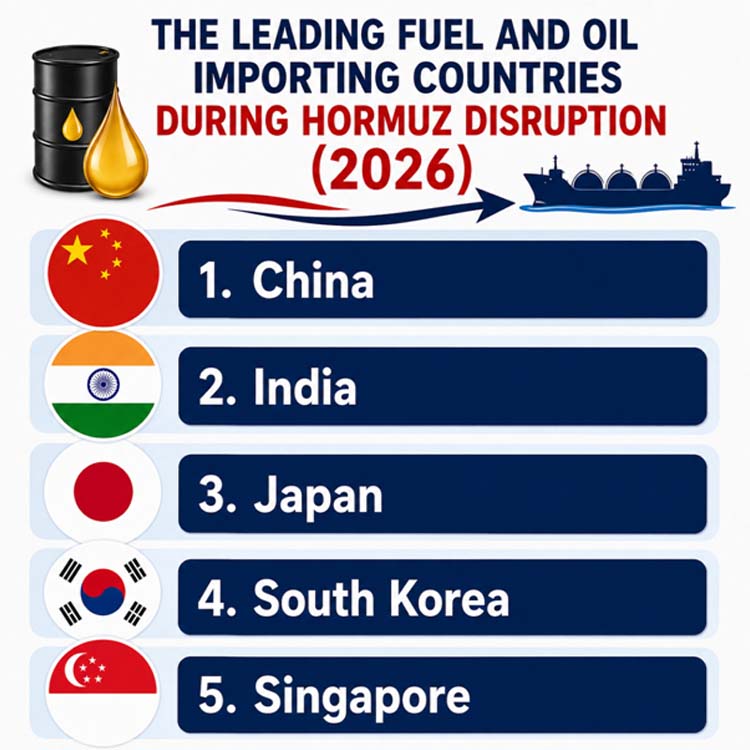
The fluctuations in the fuel trade due to the disruptions in the Strait of Hormuz have been a golden point for the exporters, but meanwhile, it is also creating some difficulties for the importing economies due to the effective discontinuity in the regular trade flows. The countries mentioned below are facing difficulties with their import of fuel and oil at present.
1. China - China is the largest crude oil importer in the global marketplace at present. China Import Data indicated that any disruptions in the Strait of Hormuz directly hurt the Chinese refiners, mainly because of the substantial dependence on imported energy. The temporary adjustment of purchasing strategies may cause severe impacts on the export activity of the country.
2. Japan - To fulfil its energy needs, Japan has been mainly importing its energy requirements from foreign trade authorities. The heavy dependence of the country on imported crude oil makes it vulnerable to global shipping disruptions. Japan Import Data listed the interruption in Gulf energy exports as the main factor impacting Japan's energy force.
3. South Korea - The intensive refining and petrochemical operations have made South Korea one of the most affected regions during the Strait of Hormuz disruption. The reliable crude oil and LNG supplies will maintain industrial productivity. As per South Korea Import Data, the import revenue of the nation will be affected, while significantly contributing to the decline in the productivity rate in manufacturing units.
4. Singapore - Wrapping up the top-most importers list getting impacted during the Strait of Hormuz disruption, Singapore stands at the top fifth. It is one of the largest refining and energy redistribution hubs of Asia. As per the Singapore Import Data, the supply interruptions in the Strait of Hormuz will affect both the domestic refining activities and the regional fuel distribution network. The operational risk throughout Southeast Asia during the trade will increase.
Winners vs Losers (Hormuz Disruption Analysis)
Potential Winners
1. Russia - Due to the Strait of Hormuz disruption in 2026, the Russian crude exporters are getting extreme benefits because of the preference of the Asian importers towards the Russian authorities, far away from the traditional Gulf suppliers.
2. United States - The American energy exporters have gained reliable access to the premium markets during the Strait of Hormuz disruption. The expectation in trade is mainly because of the stable and reliable fuel supplies.
3. Brazil - Brazil stands as the top third country benefiting from the Strait of Hormuz disruptions. The Brazilian crude producers have come across a stronger demand, mainly because of the increase in the number of importers regarding alternative Atlantic basin cargoes.
Most Pressured Economies
1. India - The Strait of Hormuz disruption has hurt the fuel import trade of India. Higher freight force, increased fuel prices, and supply diversification have created significant challenges for the domestic authorities.
2. Japan - The dependency of Japan on imported LNG and crude oil for regular activities of the consumer base has made it a country most vulnerable to the Hormuz disruption.
3. South Korea - The industrial fuel requirements in South Korea and the increasing exposure to supply disruptions have expanded the fuel trade far away from Gulf operations, increasing the overall shipment valuation from the foreign authorities.
Most Affected Fuel Commodities / Hs Code Classification
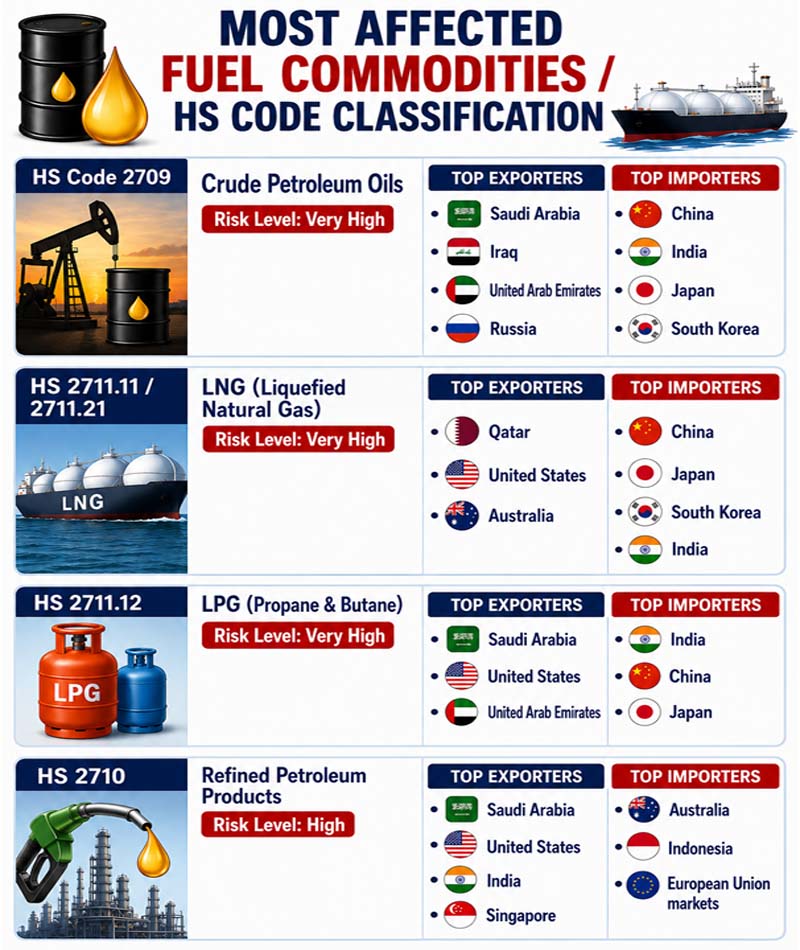
HS Code 2709 – Crude Petroleum Oils
Risk Level: Very High
Crude oil is the most affected trade category during the Hormuz disruption in 2026. Significant price increases and feedstock shortages are certain risk factors.
Top Exporters
- Saudi Arabia
- Iraq
- United Arab Emirates
- Russia
Top Importers
- China
- India
- Japan
- South Korea
HS 2711.11 / 2711.21 – LNG (Liquefied Natural Gas)
Risk Level: Very High
LNG is one of the severely affected fuel and oil categories during the Hormuz disruption. The affectivity in the trade is mainly because of the reliance on marine shipping.
Top Exporters
- Qatar
- United States
- Australia
Top Importers
- China
- Japan
- South Korea
- India
HS 2711.12 – LPG (Propane & Butane)
Risk Level: Very High
LPG trade is also getting severely affected; the requirement of the specific essential in cooking, transportation, petrochemicals, and industrial operations has increased the regular trade flow.
Top Exporters
- Saudi Arabia
- United States
- United Arab Emirates
Top Importers
- India
- China
- Japan
HS 2710 – Refined Petroleum Products
Risk Level: High
Refined fuels, mainly diesel, gasoline, and jet fuel, have come across severe trade difficulties because of the Hormuz disruptions. The increased demand rates have affected the trade flow.
Top Exporters
- Saudi Arabia
- United States
- India
- Singapore
Top Importers
- Australia
- Indonesia
- European Union markets
Commodity Risk Ranking
Very High Impact
- HS 2709 – Crude Oil
- HS 2711.11 / 2711.21 – LNG
- HS 2711.12 – LPG
High Impact
- HS 2710 – Diesel
- HS 2710 – Jet Fuel
- HS 2710 – Fuel Oil
Secondary Impact
Petrochemicals
- Fertilizer Feedstock’s
- Industrial Gases
How Does the Global Import Export Data of Import Globals Help the Energy Traders?
The Global Import Export Data of Import Globals plays a crucial role for the business authorities in navigating the volatile energy markets. The topmost factors representing the beneficial role of global import export data in the manufacturing of energy traders are,
1. Tracking of Sourcing Patterns - The proper tracking of the competitor sourcing patterns helps the emerging traders understand the methodologies they should adopt for proper regulation and shipment of top-demanded fuel and oils.
2. Monitoring of the Alternative Suppliers - The proper monitoring of the alternative suppliers' activities over the specific targeted category helps them understand the trade road that can get them positivity in their future expansion.
3. Analysis of the Buyer Behaviour - The acknowledgement and the analysis of the buyer behaviour and the investment rates put up for significant trade enhancement promote market entry strategies.
4. Evaluation of Competitor Procurement Strategies - The evaluation of the competitor procurement strategies gives the research analysts and the business authorities a proper idea regarding the formulation of pricing ranges, which can lead to positive trade output.
A Comprehensive Outlook of the Global Energy Trade in 2026
The global energy trade has been highly influenced by geopolitical developments, maritime security concerns, and supply diversification efforts. The Gulf producers have been continuously implementing alternative export solutions through pipelines to accelerate the efforts to strengthen the overall energy security trade. The exporters, including Saudi Arabia, Russia, the United States, Brazil, and Norway, are playing an important role in the balance of the global fuel market trade. The Strait of Hormuz disruption has been putting severe pressure on the import and export activities of different regions. Around one-sixth of global oil and LNG trade has been rerouted, shifting shipment activities far away from the Gulf operations.
Conclusion
The disruption caused in the Strait of Hormuz is considered vulnerable for the emerging fuel and oil traders. The crude oil, LNG, LPG, diesel, gasoline, jet fuel, and petrochemicals have been the most affected commodities. Fuel and Oil Import Export Data and Global Import Export Data provide clear visibility into the changing market dynamics. The shift of the geopolitical realities and the well-equipped, detailed trade intelligence highlighted in Import Globals global import export data helps the researchers and the business authorities navigate the uncertainty while capitalizing on the emerging opportunities.
CTA
Looking for the latest fuel and oil import and export data, you have landed at the right platform here. Import Globals resolves all your trade complexities despite your exposure to trade fluctuations. The Data set highlighted resolves the complications of the progress of trade flow. Subscribe to www.importglobals.com or email at info@importglobals.com to get deeper visibility into crude oil, diesel, gasoline, and refined petroleum trade.
FAQ’S
Que. What is the importance of the Strait of Hormuz in global fuel trade?
Ans. The Strait of Hormuz is the main maritime energy corridor for the fuel and oil trade. The connectivity of the Strait of Hormuz to the Persian Gulf to international shipping routes has made it an important player in the global fuel trade.
Que. Name the top exporting countries of fuel and oil during the Hormuz disruption in 2026.
Ans. Saudi Arabia, Russia, the United States, Brazil, and the United Arab Emirates are among the top fuel and oil exporters in the global marketplace during the Hormuz-related disruptions.
Que. Name the top affected countries of Hormuz supply disruptions.
Ans. China, India, Japan, South Korea, and Singapore are the top affected countries during Hormuz disruptions.
Que. List the top exported fuel commodities during Hormuz disruptions.
Ans. Crude oil, diesel, gasoline, jet fuel, and fuel oil are the top affected fuel commodities during the Hormuz disruption.
Que. Why is LNG the most difficult fuel to replace?
Ans. LNG is the most difficult fuel to replace because of its specialization and liquefaction facilities, the effective use and storage infrastructure, and dedicated tanker fleet.
Que. Describe how India manages supply risk in Hormuz disruptions.
Ans. India has been actively managing supply risk in Hormuz disruptions by increasing imports from Latin America, Africa, Russia, and alternative Gulf export hubs.
Que. What are the alternative routes available for crude oil export during Hormuz disruptions?
Ans. East-west pipeline, Red Sea port of Yanbu, and Habshan-Fujairah pipeline are the top routes available for crude oil exports during Hormuz disruptions.
Que. How Does Import Globals fuel and oil import export data help businesses in energy market disruptions?
Ans. Fuel and oil import export data give detailed shipment-level insights to suppliers, buyers, and importers for a proper understanding of sourcing patterns during Hormuz disruptions.
Que. Name the top industries affected by disruptions in global fuel trade.
Ans. Refining, transportation, aviation, and petrochemicals are the top affected industries by disruptions in global fuel trade.
Que. How can our Import and export data support business growth?
Ans. Our Import& export Data can support business growth via proper identification of buyers, suppliersanalysis of market demand and development of effective market expansion strategies.
Que. What information is available in our trade reports?
Ans. Our report covers Importer names, Exporter names, Shipment data, HS Code, Product Details,quantity, values, pricing information, origin country, importing country & port details.
Que. How frequently is the trade Data updated?
Ans. Our trade data is updated as on monthly basis.
Que. Where can you obtain detailed information on global fuel trade data?
Ans. Visit www.importglobals.com or email at info@importglobals.com for detailed updates on global fuel and oil trade data.