Vietnam Import Market Trends: The Supply Chain Diversification Opportunities of 2025
- Jun 13, 2026
- 52 Views
Vietnam Import Market Trends: The Supply Chain Diversification Opportunities of 2025
Vietnam has emerged as one of the strongest import authorities on the global marketplace. Its rapid industrialization and the foreign direct investment inflows have made the country a thriving import authority for international suppliers.
The diversification of the global supply chain has accelerated the role of the country as a thriving importer. Vietnam Import Data reported the sourcing operations and the trade activity as factors towards reducing the dependency on single-country supply chains.
The import sector has reached a total valuation of $422 billion in 2025. The expanding industrial production and export-oriented manufacturing have been supporting the import revenue rate. Vietnam's Global Trade Intelligence is considered beneficial for providing detailed insights into buyer behaviour, sourcing trends, and emerging market opportunities. The shipment-level trade intelligence of Vietnam is crafting the emerging market opportunities via proper acknowledgement of potential customers. The business authorities seeking expansion in the healthcare approach treatment services can identify potential customers by supplementing off-documenting patterns.
Significance of Vietnam's Imports in the Country's Economic Growth
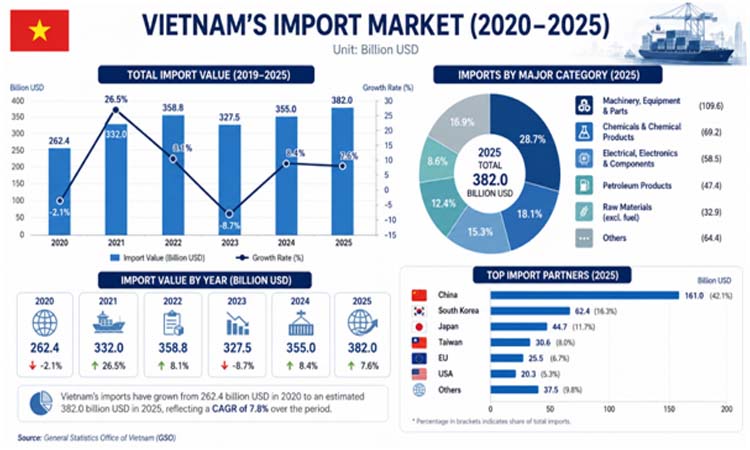
The import market of Vietnam has been serving as a fundamental pillar for economic growth. The ecosystem of the country has been mainly dependent on imported machinery, electronic components, industrial materials, and production inputs. Vietnam Customs Data has reported electronic manufacturing, automotive assembly, textile and garment production, along with renewable energy projects, as the main factors supporting the import economic growth rate of the nation.
The proper expansion of the industrial zones, special economic zones, and export processing sectors has been increasing the demand for imported capital goods. The initiatives launched by the government authorities at present are mainly focused on digital transformation, green manufacturing, and advanced technology adoption. The upgrade of the multinational corporations and the proper establishment of production facilities are supposed to maintain a strong upward trajectory.
Why is Vietnam Emerging as a Top Destination for Supply Chain Diversification on a Global Scale?
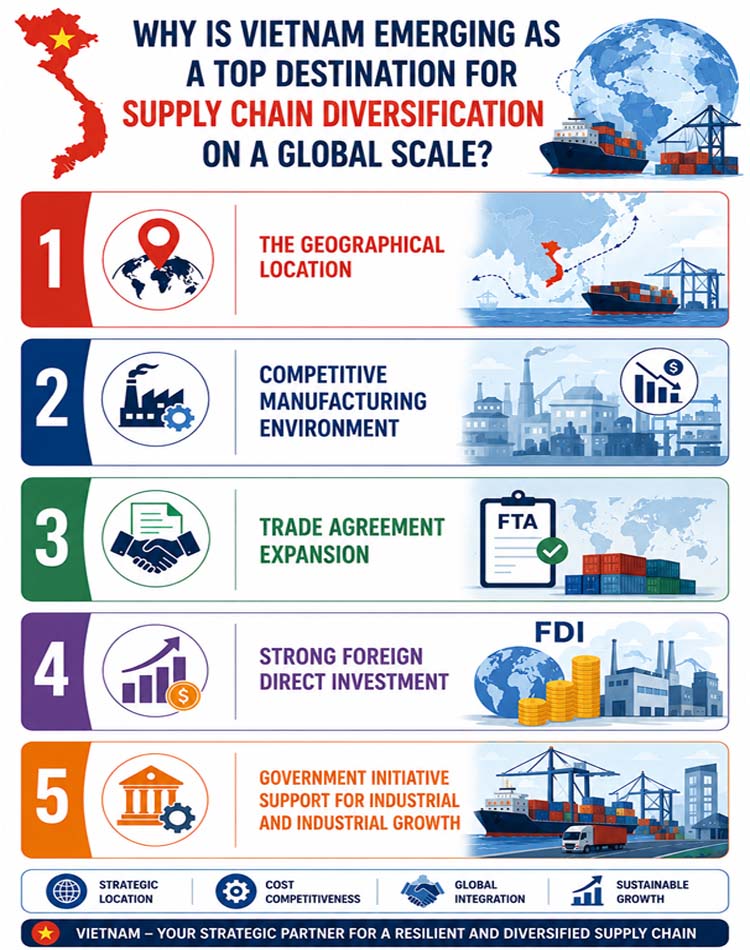
The Emergence of Vietnam as a Strategic Sourcing and Manufacturing hub is mainly because of the Following Factors
1. The Geographical Location - The location of Vietnam along the national shipping routes and the proximity of the country to major manufacturing economies have promoted the logistic efficiencies.
2. Competitive Manufacturing Environment - The Vietnam Export Data listed the low operational cost, skilled labour availability, and the business-friendly policy as the main factors that have been promoting the alternative productivity locations.
3. Trade Agreement Expansion - The country has been obtaining benefits from different free trade agreements. The bilateral agreements signed have been facilitating international trade by reducing trade barriers.
4. Strong Foreign Direct Investment - The investments made by the government authorities of different regions worldwide have strengthened the industrial capabilities. It has even increased the demand for imported production inputs.
5. Government Initiative Support for Industrial and Industrial Growth - The authorities of Vietnam have continued to invest heavily, mainly in the logistics port and industrial development. The significant investment in such sectors has enhanced trade competitiveness.
What Information is Included in Vietnam Import Trade Data?
The Global Import Trade Data of Vietnam is a proper result of the comprehensive shipment level analysis. The import information of the country gives information regarding the specific shipment level analysis. The database basically includes importer names, exporter names, product description, export classification, and shipment quantity. Trade values, unit prices, country of origin, import information, shipping dates, transportation methods, and buyer information.
All this information, concluded in one place, helps the business authorities identify the profitable opportunities. It even helps the business holders target the market development rate. It promotes the establishment of new trade partnerships. The landscape of Vietnam imports is set up as per the growing consumer-based demand rates while maintaining overall trade compliance.
Top 10 Imported Products of Vietnam in 2025
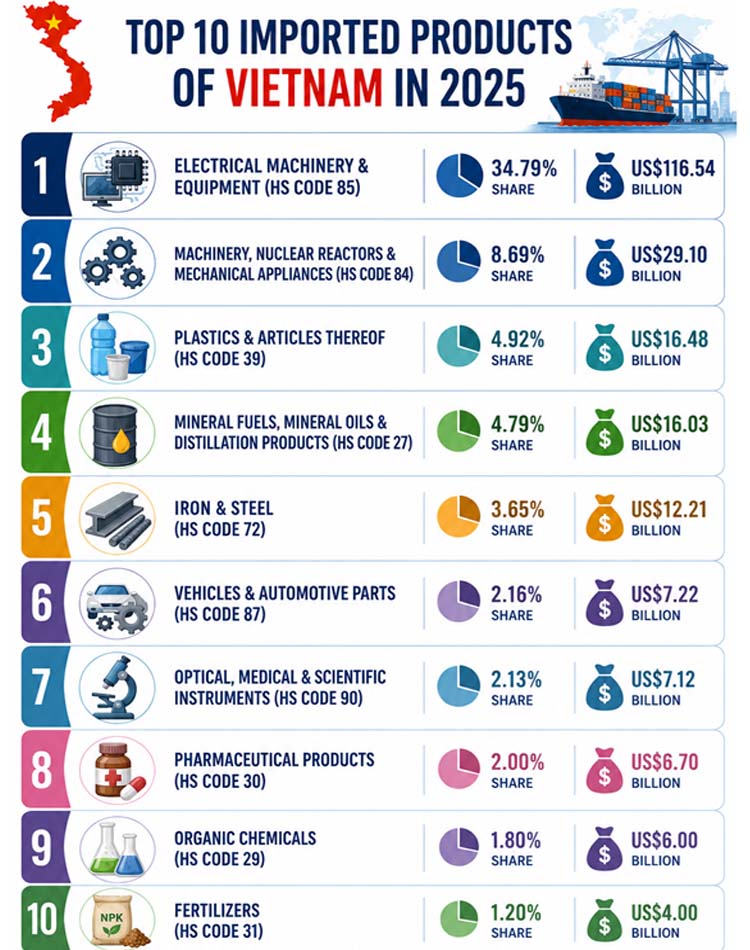
- Electrical Machinery & Equipment (HS Code 85) — 34.79% share — US$116.54 Billion - Electrochemical machinery represents 34.79% of the import market share of Vietnam. Semiconductor, integrated circuits, electronic components, telecommunication, and consumer electronics are the top traded categories. China, South Korea, Taiwan, and Japan have been facilitating the import of electric machinery into Vietnam.
- Machinery, Nuclear Reactors & Mechanical Appliances (HS Code 84) — 8.69% share — US$29.10 Billion - Machinery and mechanical appliances are the top imported category of Vietnam and represent 8.69% of Vietnam's import market share. The Vietnamese industries are relying on the improvement of efficiency and technological capabilities for food processing and automotive manufacturing essentials, along with the continuous investment in industrial infrastructure, which has maintained the overall trade of machinery.
- Plastics & Articles Thereof (HS Code 39) — 4.92% share — US$16.48 Billion - Plastic and articles account for 4.92% of Vietnam's import share. Electronics, automotive components, and packaging construction are mainly demanding for plastics and articles. The domestic production is not able to fully satisfy the industrial demand rate, due to which the Vietnamese authorities are mainly importing the specific category.
- Mineral Fuels, Mineral Oils & Distillation Products (HS Code 27) — 4.79% share — US$16.03 Billion - Mineral fuels report 4.79% of Vietnam's import trade share. The domestic energy resources and the quantities of fuels to satisfy growing industries are not being produced at a sufficient rate. The countries in the Middle East, Southeast Asia, and East Asia have been promoting the import of mineral fuels.
- Iron & Steel (HS Code 72) — 3.65% share — US$12.21 Billion - Iron and steel represent 3.65% of Vietnam's import market share.Iron and steel are mostly used in transportation infrastructure, shipbuilding, machinery production, and automotive manufacturing. The rapid urbanization of the industrial sectors and the development of infrastructure investment have been maintaining the import revenue rate.
- Vehicles & Automotive Parts (HS Code 87) — 2.16% share — US$7.22 Billion - Vehicles and automotive parts report 2.16% of Vietnam's import share. The major suppliers include Thailand, Indonesia, Japan, South Korea, and China. The automotive industry is expanding mainly because of the imported parts and technologies.
- Optical, Medical & Scientific Instruments (HS Code 90) — 2.13% share — US$7.12 Billion - Optical and scientific instruments account for 2.13% of Vietnam's import market share. The research institutions, educational facilities, and industrial quality control operations are demanding specific imports. The United States, Germany, Japan, China, and South Korea have been crafting the overall trade.
- Pharmaceutical Products (HS Code 30) — 2.00% share — US$6.70 Billion - Healthcare expenditures and aging population, along with the increased access of the country to medical services, have increased the overall import of pharmaceutical essentials. Germany, France, Switzerland, and the United States have been crafting the trade landscape.
- Organic Chemicals (HS Code 29) — 1.80% share — US$6.00 Billion - Organic chemicals account for 1.80% of Vietnam's import trade share. The domestic productivity is not enough to maintain the proper fulfilment of the trade standards. The imports are basically sourced from foreign authorities to support the industrial production in order to maintain the export manufacturing rate.
- Fertilizers (HS Code 31) — 1.20% share — US$4.00 Billion - Fertilizers stand as the top 10th one, accounting for 1.20% of Vietnam's import market share. Nitrogen fertilizers, phosphate fertilizers, and compound fertilizers are among the top-traded categories. Fertilizers are mainly used in the agricultural industry to improve productivity rates while supporting the production of rice, coffee, rubber, fruit, and other export-oriented agricultural commodities.
Top Import Partners of Vietnam in 2025
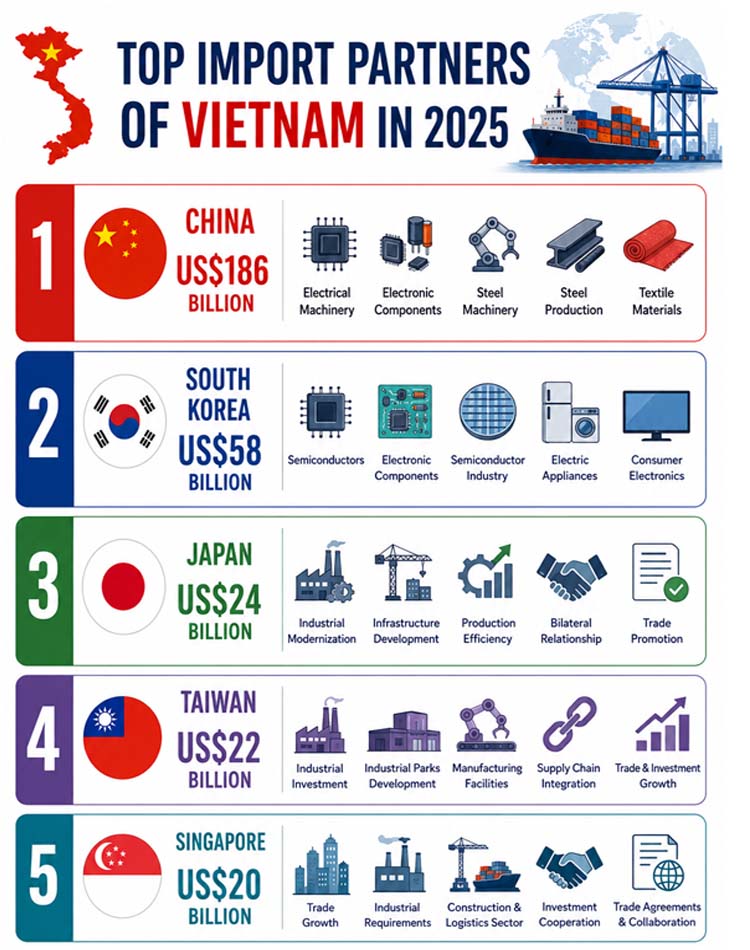
- China — US$186 Billion - As per China Export Data, the country is one of the largest import partners of Vietnam. The trade of electrical machinery, electronic components, steel machinery, steel production, and textile materials has been swapping bilateral integrity. The participative activity and the geographic proximity, along with the proper establishment of trade relationships, have maintained the stability in trade.
- South Korea — US$58 Billion - South Korea accounts for $15 billion of Vietnam's imports. As per South Korea Export Data Semiconductors, electronic components, semiconductor industry, and electric appliances are the top traded essentials. The electronics industry, along with consumer electronics manufacturing, has been mainly importing Vietnamese electronic essentials.
- Japan — US$24 Billion - Japan accounts for $24 billion of Vietnam's imports. Japan Export Data represented the Industrial modernization, infrastructure development, and production efficiency as the factors impacting Vietnamese imports while promoting the bilateral relationship.
- Taiwan — US$22 Billion - As per Taiwan Export Data, the country accounts for $22 billion of Vietnam's imports. The increased investment in industrial parks and the manufacturing facilities has strengthened the trade and supply chain integration.
- Singapore — US$20 Billion - Singapore Export Data reported $20 billion of share in Vietnam's imports. The region's trade growth and growing industrial requirements have crafted the trade integrity. The construction and logistics sector, along with the investment cooperation and the trade agreements, has been maintaining proper trade between these economies.
Opportunistic Industries Promoting Supply Chain Diversification
1. Electronics Industry Expansion - The Vietnamese authorities have identified significant opportunities for suppliers of semiconductors, components, automation systems, and manufacturing technologies.
2. Renewable Energy Infrastructure - It has continued to generate demand for solar panels, wind power equipment, energy storage systems, and grid infrastructure.
3. Automotive and Electric Vehicle Growth - Vietnamese authorities have been looking for charging infrastructure, electronic systems, and advanced vehicle components while promoting the integrity of the global supply chain and standard maintenance.
4. Logistics and Warehousing Development - The increase in the demand for logistics equipment and warehouse automation has raised the requirement for transportation infrastructure upgrades.
5. Healthcare and Medical Equipment - The rising healthcare investments have been supporting the import of diagnostic equipment while promoting the bilateral trade relationship with the top export suppliers.
Government Initiatives Supporting the Import Growth
1. The Development of Infrastructure - The major investment made by the government authorities in ports, airports, and logistics corridors, has overall strengthened trade competitiveness.
2. Digital Transformation Programs - The government-led initiatives launched for the modern technology adoption across different industries have increased the demand for advanced imported equipment.
3. Green Manufacturing Policies - The management authorities right now are sustainability-focused, mainly on the imports of energy-efficient machinery and environment-friendly production technologies.
4. Industrial Development - The proper development of the industrial parks has maintained the attractiveness of the foreign manufacturers and has increased the import requirements.
5. Trade Facilitation Reforms - The customs modernization and trade process improvement have reduced the business cost. It has even streamlined the import operations as per the global trade compliance.
How Does the Vietnam Import Data of Import Globals Support Business Growth?
Import Globals is considered a reliable tool for the proper expansion of the market approach. The detailed insights craft the strategic trade landscape with active intelligence regarding the latest shipments from different regions.
1. Identification of Buyers - The detailed trade insights regarding the specific shipments of Vietnam, as per the domestic consumer base, help the research analysis craft marketing strategies with active identification of buyers.
2. Competitor Strategy Analysis - The analysis of the competitor strategies helps in the proper evaluation of the marketing strategies.
3. Emerging Economies Discovery - The latest trade insights highlighted in the platform regarding specific shipments of different regions reveal the top demanded categories. This, in short, promotes the sourcing strategies of the top traders.
4. Optimization of Marketing Strategies - The proper optimization of the marketing strategies helps the research analysts and the traders keep a record of the market shifts while supporting the export growth rate.
5. Reduced market Entry Risks - The detailed trade insights highlighted in the platform back up the informed decision of the marketing authorities.
Key Factors to Resource From the Vietnam Import Data of 2025
1. Supply chain diversification trends
2. Latest renewable energy Equipment imports
3. Regional sourcing shifts
4. Emerging industrial zones
5. Competitive pricing intelligence set up as per trade standards
Conclusion
The import market overview of Vietnam is a proper result of the increasing sourcing ability of the nation. The dependence of the country on the latest foreign exporters and the generic trade is highlighted in Import Globals “Vietnam Import Trade Data”. The specific dataset caters to the needs of the business authorities regarding service expansion.
The global compliance maintained as per the revolutionary standards serves as one of the most useful factors, mainly for the identification of supplier opportunities and the pricing ranges adopted worldwide. The import shipment information of Vietnam promotes market visibility. The customer collaboration and the long-term trade success are mainly fostered by the import sector of the nation.
CTA
Looking for the latest updates on Vietnam’s imports? Get your acquired trade details as per the market fluctuations here at Import Globals. Subscribe to www.importglobals.com or email info@importglobals.com for the latest trade activities on Vietnam’s imports.
FAQ’S
Que. What is the estimated import trade value of Vietnam in 2025?
Ans. The estimated import trade value of Vietnam in 2025 is $420 billion US dollars.
Que. What are the largest imported categories in Vietnam?
Ans. Electrical machinery, machinery and equipment, mineral fuels, plastics, and organic chemicals are the largest import categories of Vietnam.
Que. What is the Vietnam import data from Import Globals?
Ans. Vietnam import data from Import Globals is a categorized and detailed trade information of the competitive sourcing potential of the country. It helps the authorities expand the trade agreements as per the global trade compliance.
Que. Why is Vietnam an important source for supply chain diversification?
Ans. Vietnam is an important source for supply chain diversification because it helps the authorities expand their trade agreements, along with the understanding of the proper growth of industrial capacities.
Que. Name the top import partner of Vietnam in 2025
Ans. China is the largest import partner of Vietnam in 2025.
Que. How can Vietnam Import Data support business growth?
Ans. Vietnam Import Data can support business growth via proper identification of buyers, analysis of market demand and development of effective market expansion strategies.
Que. Which industries are benefiting Vietnam's import growth?
Ans. Electronics, renewable energy, automotive manufacturing, and logistics sectors are benefiting from Vietnam's import growth.
Que. What information is available in Vietnam Import Shipment Data?
Ans. HS code, shipment values, quantities, pricing data, and sourcing trends are available in Vietnam import shipment data.
Que. How frequently is the Vietnam Custom Data updated?
Ans. Vietnam import trade data is updated as per the customs reports and the availability of shipment reporting.
Que. Where can you obtain detailed information on Vietnam Import Data?
Ans. Visit www.importglobals.com or email info@importglobals.com for more information on Vietnam Import Data.