Trade between Sweden and the Nordic Region and Baltic States in 2025–26
- Apr 03, 2026
- 52 Views
Trade between Sweden and the Nordic Region and Baltic States in 2025–26
Sweden's economy is strongly linked to those of its neighbors. Sweden's most "frictionless" trading area is made up of the Nordic countries (Denmark, Finland, Norway, and Iceland) and the Baltic States (Estonia, Latvia, and Lithuania). This is because shipping lanes are short, value chains are connected, standards are shared (especially inside the EU), and business relationships have been built over many years. In 2025–26, the region will be even more significant because businesses want to be strong.
As per Sweden Import Data by Import Globals, they want shorter supply chains, reliable channels, clear laws, and partners that can quickly move goods in both directions. Sweden's commerce with its neighbors isn't simply one story; it's a succession of patterns that alter according on who the partner is. Norway is usually Sweden's most important Nordic trading partner when it comes to goods, given to close industrial ties and commerce across borders.
Denmark is A Key Partner and a Major Gateway for Manufacturing and Logistics in Both Directions
Finland and Sweden are quite near to each other since they exchange chemicals, machinery, and logistics in the Baltic Sea. As per Sweden Export Data by Import Globals, the Baltic States are not very big, but they are very important for trade routes, transport corridors, and manufacturing networks in the Baltic Sea. They are bigger than their size in various sectors, like wood goods, metals, equipment components, and re-exports. It's helpful to look at the most current official trade snapshot and then think about what those changes signify for the next year to get an idea of what will happen in 2025–26.
What the Numbers Say for 2025–26
1) The Nordic Neighborhood is Still Sweden's Principal Commercial Hub for "High-volume" Goods
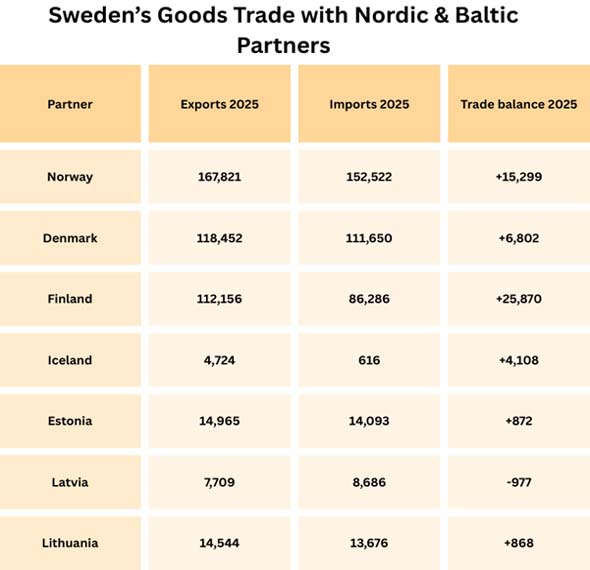
Even though energy prices are changing, industrial cycles are slowing down in some regions of Europe, and supply chains are being redesigned, Sweden's Nordic commerce is still big and essential. As per Sweden Import Export Trade Data by Import Globals, the numbers above demonstrate that Nordic trade is far bigger than Sweden's Baltic commerce. This is because the Nordic economies are bigger and more integrated.
2) Norway is Known for Its Stability and a Big Decline in Imports
In the snapshot, Sweden's exports to Norway are pretty much the same from year to year, while its purchases from Norway have dropped a lot. This kind of pattern usually shows changes in energy-related flows, prices, inventory cycles, or the way things are sourced. The main point for 2025–26 is that commerce between Sweden and Norway is so vast that even little changes in categories like energy, metals, and industrial inputs can impact the totals.
3) Denmark Seems to Be Growing Steadily in All Directions
In the most recent picture, both exports and imports are going up with Denmark. As per Sweden Import Custom Data by Import Globals, that fits with Denmark's function as a country with a lot of manufacturing and pharmaceuticals, as well as a link between Scandinavia and continental Europe for logistics. Denmark will still be a key partner for trade in industrial goods, chemicals/pharma, machinery, and transportation in 2025–26.
4) Finland: Swedish Exports Fall but Imports Climb
Sweden sends less goods to Finland, but Finland sends more goods to Sweden. This shows that industrial supply chains are rebalancing, which happens when: demand for a sector changes (for example, machinery vs. raw materials), price changes affect import prices, or manufacturing schedules change within shared Nordic value chains. Trade between Sweden and Finland will still be very connected to manufacturing inputs and intermediate commodities in 2025–26. As per Sweden Import Trade Analysis by Import Globals, this is because reliable freight and predictable industrial demand are what make the two countries competitive.
The Baltic States: Lower Totals, High Strategic Importance
Sweden's commerce with Estonia, Latvia, and Lithuania is smaller in terms of money, but it is nonetheless important for three reasons:
- Logistics on the Baltic Sea and short lead times
- Short maritime routes make it easy to send things often and restock them as needed. This is especially useful for parts and semi-finished goods.
- Networks for manufacturing and "nearby capacity"
Many Baltic suppliers are set up to make things in medium quantities, like components, packaging, wood products, and specialized services related to the trade of goods.
Routing Trade and Re-Exporting
As per Sweden Exporter Data by Import Globals, like many EU trade relationships, some documented commerce shows routing through hubs (warehousing, transshipment, distribution), not only where the final product was made.
In the data snapshot, Latvia and Lithuania show high export increases from Sweden (particularly Latvia), while Estonia shows a small drop in exports but an increase in imports. This suggests that demand patterns are changing in the region.
What Really Goes Between Sweden and Its Neighbors
As per Sweden Importer Data by Import Globals, partner totals are useful, but the "pattern" of commerce is best seen by the usual category flows:
- Because of linked manufacturing and shared industrial ecosystems, a lot of industrial machinery, electrical equipment, and vehicles/parts migrate across Nordic borders.
- Chemicals, drugs, and specialist manufactured goods are important to commerce between Sweden and Denmark.
- In Nordic-Baltic trade, forest products and packaging are important since each region has its own specialties and there is a consistent need for them.
- Sweden trades a lot with its neighbors in metals and industrial products, such as steel value chains and processing inputs.
- As per Sweden Import Trade Statistics by Import Globals, energy-related items and industrial inputs that use a lot of energy can have a big effect on the totals between Sweden and Norway.
In 2025–26, the most important "demand drivers" behind these flows are: cycles in industrial output in Northern Europe, freight costs and port/route reliability, exchange-rate and price effects on high-value categories, and corporate supply-chain risk policies (dual sourcing, closer suppliers).
Why Geography Still Wins in 2025–26: Logistics Corridors
Regional trade isn't only about who buys what; it's also about how fast and reliably things can move:
- As per Sweden Import Shipment Data by Import Globals, roads and railroads across the Scandinavian peninsula make it possible for high-frequency, short-cycle industrial trade to happen.
- Ro-ro ferries and shipping in the Baltic Sea make it possible to have regular weekly schedules, which are great for standardized commodities and parts.
- The ports around the Baltic Sea make it possible for both direct movements between Sweden and the Baltic Sea and movement into continental Europe.
- As per Sweden Import Export Trade Analysis by Import Globals, the Nordic-Baltic neighborhood is useful in 2025–26 because it is fast and predictable. That's exactly what companies desire when things like shipment delays, sudden changes in compliance, or drops in demand make it harder to manage sourcing from far away.
Outlook for 2025–26: What to Watch
1) Demand from Businesses Compared to Normalizing Inventory
You can notice reduced trade values even when the ties between the companies stay robust if they keep less inventory.
2) How Energy Prices Affect Nordic Totals
Categories related to energy can swiftly modify the picture of imports and exports, especially when Norway is involved.
3) Areas of Expansion in the Baltic Sea
As per Sweden Export Import Global Trade Data by Import Globals, even if the overall numbers are fewer, certain types of goods (such wood-based items, parts, equipment parts, and re-exports) can expand quicker in the Baltics than in more developed Nordic lanes.
4) Rules and Regulations from the EU
Changes in reporting, sustainability regulations, and due diligence obligations in the EU might affect where Swedish companies buy and sell by changing their supplier selections and pricing structures.
Conclusion
Sweden's commerce with the Nordic region and the Baltic States in 2025–26 can be best described as core integration with the Nordics and strategic adjacency with the Baltics. The Nordics are still Sweden's biggest trading partner in the region, while the Baltics provide flexible capacity, quick shipping routes, and strong category strengths. As businesses focus on supply chains that can handle stress and shorter lead times, Sweden's geographic advantage becomes even more important. This will make location a competitive asset for trade in 2025–26. Import Globals is a leading data provider of Sweden Import Export Trade Data.
FAQs
Que. In this group, which Nordic country does Sweden do the most business with?
Ans. Norway usually has the highest overall value among the Nordic countries because of strong commercial linkages between them.
Que. Why are the Baltic States strategically essential even though their trade values are lower?
Ans. They make it easy to transfer goods across the Baltic Sea by providing short shipping routes, local manufacturing networks, and effective routing alternatives.
Que. What kinds of items are most common in Sweden's regional trade?
Ans. Industrial commodities like machinery, automobiles and parts, chemicals, metals, and forest-related items are often the most important. Energy-linked movements can also change the totals.
Que. What will have the most effect on 2025–26?
Ans. Changes in the industrial cycle (demand and inventories) and price/value effects linked to energy, which are most obvious in trade between Sweden and Norway.
Que. Where to get detailed Sweden Import Export Global Data?
Ans. Visit www.importglobals.com.